
Reviews
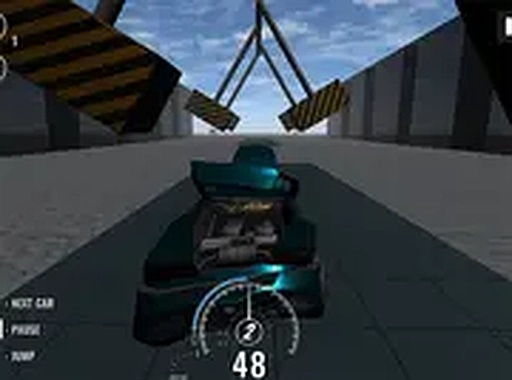
Car Behavior Sandbox succeeds in delivering a focused physics simulation without unnecessary complexity. The open environment encourages creative driving, from precise drifts to daring jumps. The damage modeling is particularly impressive, providing clear visual feedback that ties directly to your actions. Controls are responsive, making it easy to attempt complex maneuvers. While it lacks a structured campaign, the freedom to explore and experiment keeps the experience fresh. It is an excellent choice for anyone curious about vehicle dynamics or looking for a relaxing yet engaging driving game.
Description
Core Driving Experience
This game puts you behind the wheel of a car in a large, interactive space. The main draw is the realistic vehicle behavior. Every turn, acceleration, and collision is calculated based on real-world physics principles. You can push the car to its limits, performing sharp drifts around corners or accelerating over uneven ground to see how the suspension and traction respond. The simulation focuses on how weight transfer, surface friction, and impact force affect the car's movement, providing a deep learning experience for driving enthusiasts.
Environment and Interaction
The world is designed as a playground for your vehicle. You will find urban areas with tight alleys, open fields for high-speed runs, and ramps for aerial stunts. Each surface type changes the car's behavior. Gravel reduces grip, while asphalt allows for precise steering. You can also interact with other objects in the environment, such as barriers and parked vehicles. The game does not punish failure; instead, it encourages repeated attempts to master different driving techniques. This open-ended structure lets you create your own challenges, like trying to land a perfect jump or drifting through a specific course.
Visual Feedback and Damage Modeling
A key feature is the detailed damage system. When you crash into a wall or another car, the vehicle shows visible effects. You will see dents appear on the body panels, scratches along the paint, and parts like bumpers or mirrors can deform or detach. The severity of the damage is tied directly to the speed and angle of the impact. A gentle tap might leave a small scuff, while a high-speed collision can crumple the front end. This visual feedback adds a layer of consequence to your actions, making each driving session feel unique and rewarding as you learn to avoid costly mistakes.
Controls and Accessibility
The controls are straightforward, designed for quick learning. You use the keyboard arrow keys or mouse inputs to steer, accelerate, and brake. The response is smooth, allowing for fine adjustments during complex maneuvers. For a more immersive view, the game supports full-screen mode. There are no complex menus or tutorials to navigate. You simply select your vehicle and start driving. This simplicity makes the game accessible to players of all ages, while the underlying physics depth keeps experienced drivers engaged. The lack of strict goals means you can focus purely on the joy of driving and experimentation.
Creative Experimentation
The sandbox nature of the game shines when you start testing limits. You can try different approaches to the same obstacle. For example, hitting a ramp at low speed produces a small jump, but approaching at high speed sends the car flying. You can also experiment with different angles to see how the car rotates in the air. The damage system adds another layer, as a poorly executed stunt can leave your car damaged, affecting its handling. This encourages careful planning and repeated attempts. It is a safe space to learn about vehicle dynamics without real-world consequences.
03 Comments
Sign in to comment
You must be logged in before posting a review or rating.
No account? Create one
No comments yet. Be the first to comment!